



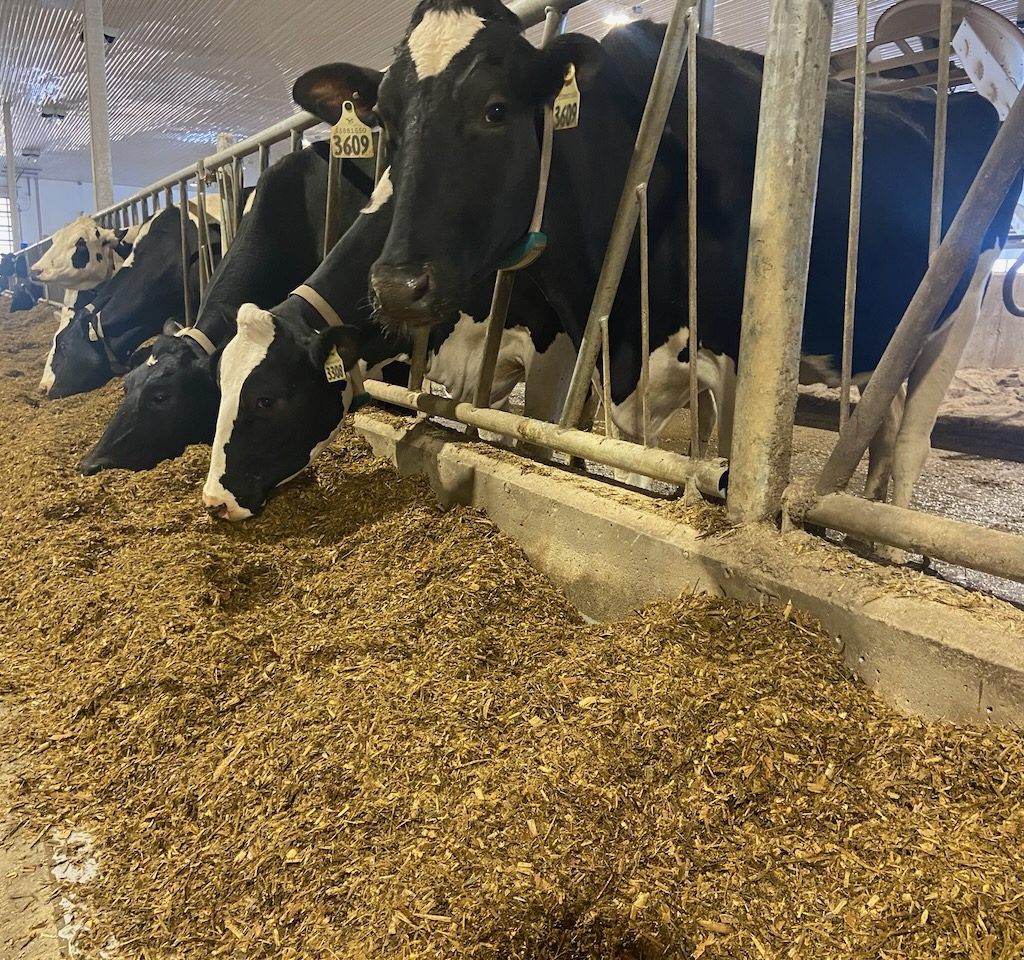
Separated whey proteins and lactose fed in dairy cow total mixed rations up to about 15 per cent of the ration.
The waste product could replace some high-moisture corn in dairy cow diets.
Why it matters: Waste solids-not-fat and whey from dairy processing are an environmental concern and are costly to ship due to their water content.
Read Also
Cutting calf losses: Experts highlight management, health strategies
Canadian veterinarians outline how better yard management, vaccination, calving practices and timely colostrum can help reduce calf losses and improve herd health.
Katie Wood, an associate professor in the department of Animal Bioscience at the University of Guelph, says researchers were approached by small dairy processors concerned about the cost of shipping out waste product at $1,000 per load – when that load was mostly made up of water.
“Although there were lots of good nutrients in the byproduct, the water level was quite high, which means if we could make it into commodities, it would be pretty sweet,” she said at the annual Dairy at Guelph research day.
Wood is a beef researcher who got involved because there was interest in the byproduct in feedlots. However, most of the research has focused on feeding the concentrate to dairy cattle.
The first problem was how to separate the nutrients from the water and so a multidisciplinary team including food science and engineering faculty was formed, and Tatum Schooley worked on the challenge for her masters degree in the department of Animal Biosciences.
Schooley says that half of the solids-not-fat and whey created in dairy processing is used in other food products. Some is used in other industries, but it results in a surplus that has to be managed.
There are other dewatering options, but they are expensive.
So Schooley and the engineering faculty looked for other technologies that would separate milk proteins and settled on using bentonite. Adding bentonite to the byproduct resulted in a whey protein bentonite slurry and a clear lactose liquid that floated on top.
The different fractions can be separated using a pump.
It was found that the separated fractions had similar available energy to high moisture corn and could be added to a total mixed ration (TMR) on farms without seepage or the TMR becoming too sticky.
“Bentonite clay absorbs, or kind of adheres to the whey proteins, and that complex settles to the bottom of the solution, which can then be separated from the larger lactose supernatant,” she says.
The lactose liquid can then be further filtered and results in a 15 per cent dry matter product.
The process could also help rumen health as bentonite helps buffer sudden changes in the rumen and could help reduce subacute rumen acidosis. The lactose could also help to maintain healthier rumens.
The researchers only have preliminary results yet for their feeding trials, but Schooley says body weight, body condition, milk yield and milk fat were unaffected by using the separate lactose and proteins. However, there was some evidence of increased milk protein levels and a decrease in milk lactose with more lactose fed in the diet.