



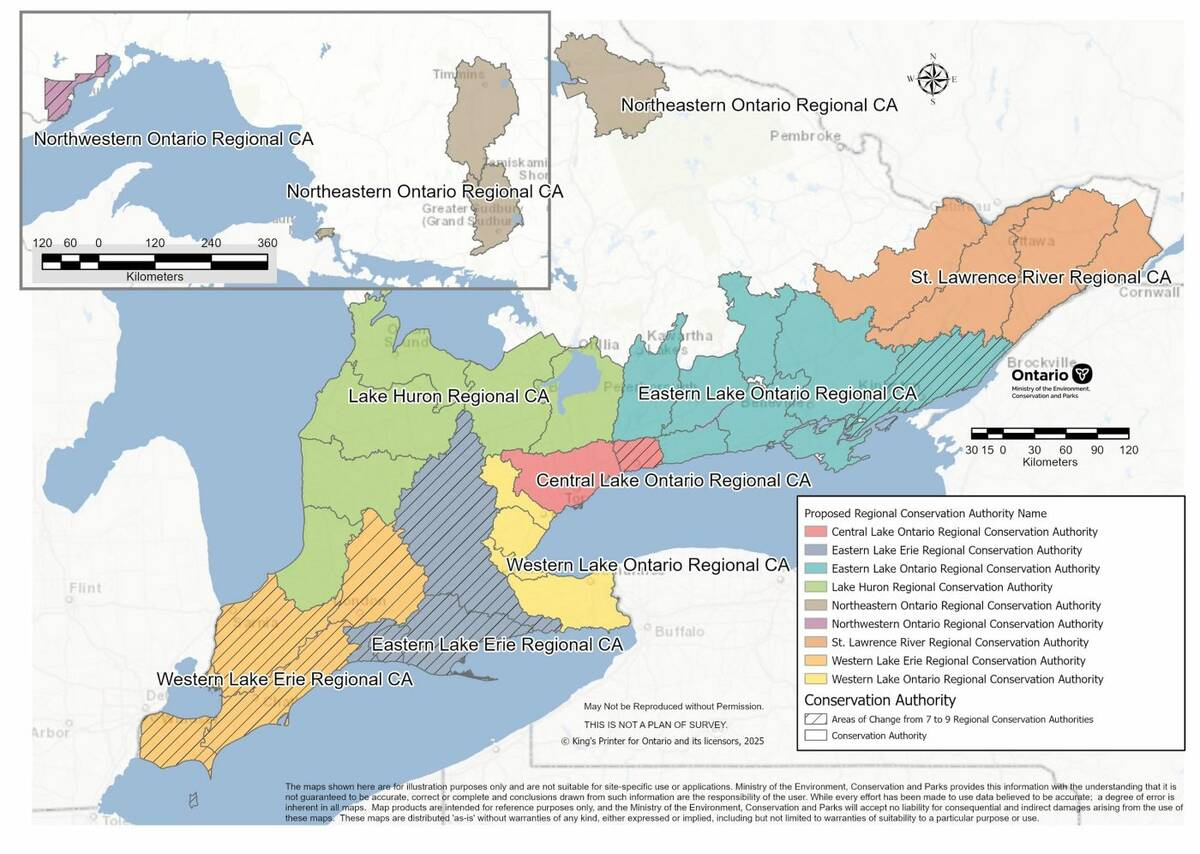
The Ontario government is moving ahead with plans to amalgamate the province’s 36 conservation authorities (CAs) into nine.
Though two more than the originally proposed seven consolidated regional authorities, many questions remain on how the move will impact programming and governance.
WHY IT MATTERS: Farmers are the largest landowners in the areas influenced by conservation authorities.
Ontario currently has 36 CAs based on watershed boundaries, which operate as separate entities. With consolidation plans being made public in October 2025, farm and conservation groups lobbied for some 19 authorities in the new system — again based on provincial watersheds.
Read Also

How to start variable-rate fertilizer application
Variable-rate fertilizer can improve your field’s yield uniformity – but don’t expect huge fertilizer savings, an Ontario agronomist cautions.
Ontario’s environment minister Todd McCarthy made the announcement on March 10, providing further detail on how the government intends to operate the amalgamated regions, and the additional costs incurred during the transition. McCarthy said consolidated regional CAs “would reduce administrative duplication, redirect resources to front-line conservation and modernize permitting to help the province deliver on its plan to protect Ontario by cutting red tape.”
Lower-tier community participation restricted
Under the government’s new structure, the nine consolidated authorities will operate under the Ontario Provincial Conservation Agency — created as an oversight body in 2025. Additionally, the provincial agency will administer $20 million, plus an additional $3 million annually, to facilitate the amalgamation process.
Each existing CA will provide representatives for transitional committees.
The new system will also feature watershed councils within each of the consolidated regions. These councils will, as the press release describes, “help identify local priorities for watershed-based conservation programs and services.”
“Regional conservation authorities would remain municipally governed, with regional municipalities, counties and cities appointing members to conservation authorities. Lower-tier municipalities in counties, such as towns and townships, will no longer be participating municipalities of a conservation authority under this approach.”
Speaking on condition of anonymity, a source within Ontario’s conservation sector said the government’s latest moves are not surprising — they had been anticipated for some time — but appear to be adding complexity rather than reducing bureaucracy.
Streamlining application processes and development requirements across regions could have been accomplished without consolidation, they said, and the establishment of another higher governance seems unnecessary if local structures remain more or less the same. Not allowing towns, townships and other similar communities to participate in governance is also a concern. Speaking more generally, they said the now-released details indicate many recommendations provided during the now-passed consultation period were ignored.
“The whole process will come at the expense of taxpayers,” said the source, adding it’s not entirely clear who will hold responsibility for source water protection — a central purpose of CAs — under the new system, given the Clean Water Act currently says local board of directors hold that responsibility.
“Nine is better than seven, but it’s not 36. Our comments are not reflected in what they’ve done.”
A statement from Hamilton Conservation Authority — an authority mentioned by minister McCarthy in his address as an example where overlapping jurisdictions cause development headaches — said the amalgamation plan is similarly not what conservation staff and board members advocated for.
“We support modernization, but dismantling a high-performing authority that is already meeting provincial objectives does not advance that goal,” Credit Valley Conservation (CVC) chair Michael Palleschi said March 19 in a separate release, noting CVC’s current average processing time for development permit applications.
“Transitioning to a new regional bureaucracy would almost certainly slow approvals while staff, systems and governance structures are reorganized.”
‘Serious concerns’
The Christian Farmers Federation of Ontario (CFFO) published a response on March 11, indicating the organization’s disappointment the advice provided by farm organizations had little effect.
“CFFO is disappointed that the government did not take the advice of the farm organizations in Ontario to align authorities with the 19 watersheds in the province. We believe this would have been a much more logical plan.
“Making these changes so we can get shovels into the ground faster for building homes and more infrastructure, doesn’t justify such a change. CFFO believes a less disruptive and more productive approach would have been more beneficial allowing each watershed to address their own regulations.”
The National Farmers Union – Ontario (NFU-O) published a strongly worded response two days later, saying the organization is “dismayed” at the government’s plan.
“This reduction is driven by a government mandate to support the building of new homes and infrastructure, and follows years of continued attempts to limit the reach of CAs. This, coupled with recent laws and policy changes like the More Homes Build Faster Act (2022), and Protect Ontario by Building Faster and Smarter Act (2025), illuminate a short-sighted approach that does not compensate for long-term environmental compromises and ultimately fails to implement best practice methodologies as defined by experts.”
While the revised proposal now requires regional CAs to establish watershed councils with Indigenous representatives and stakeholders from agriculture, the development industry and other local sectors, there will still be a 75 per cent reduction in the number of authorities, and NFU-O said “serious concerns around transparency, supports for farmers, and the integration of localized knowledge in decision making remain.”
Speaking March 12, Ontario Federation of Agriculture president Drew Spoelstra reiterated OFA’s support for streamlining regulatory processes, but disappointment with the province’s overall plan.
“We had put forward a proposal to see a watershed-based model with 18 or 19 authorities instead of nine,” Spoelstra said. “Now we’re turning our attention to making sure farmers’ voices are heard. We’re virtually the biggest landholder, farmers are, across the province.… Farmers own a lot of that landscape conservation authorities are working on and regulating.”
“The other piece is around stewardship programs. We don’t want to see that effort lost either. I think there’s a lot of good things we can take from the former system, the current system, and migrate that into the new system.”
Legislation to enact the government’s CA consolidation plan will be tabled once the legislature is back in session.